 Support schemes
The GST Voucher is not one payment, and that is where the confusion starts
Cash in August, MediSave for seniors, U-Save on the utilities bill and an S&CC rebate every quarter: four parts with four different tests. Here is how each works in 2026 and why the amounts should never be added together.
In brief
- The permanent GST Voucher has four parts: Cash, MediSave, U-Save and the S&CC Rebate. Each has its own test and goes to a different place.
- For 2026, GSTV – Cash is S$850 or S$450 for eligible adults with assessable income of up to S$39,000, depending on the Annual Value of their home.
- U-Save and the S&CC Rebate go to HDB households automatically; Cash and MediSave go to individuals.
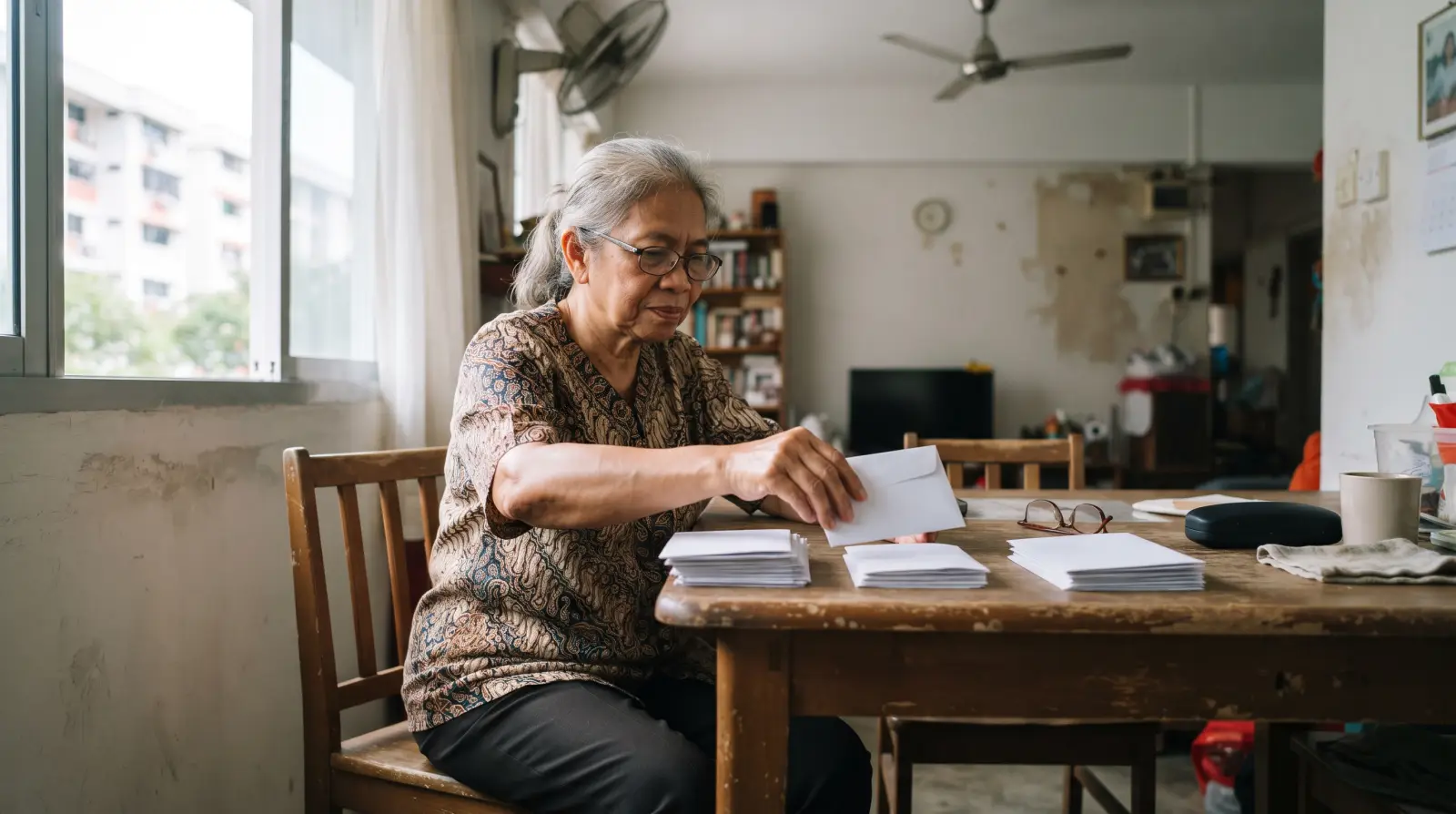
Ask three neighbours at the void deck what the GST Voucher paid them this year and you may get three different answers, all of them correct. One remembers a bank credit in August. Another noticed a smaller utilities bill. A third, past 65, saw an addition to her MediSave account. They are describing the same scheme, but not the same payment.
That is the first thing to understand about the GST Voucher (GSTV). It is not one sum of money. It is a permanent scheme, introduced in Budget 2012 to help lower- and middle-income Singaporean households with what they pay in Goods and Services Tax, and it has four separate components. Each one has its own eligibility test, its own timing and its own destination.
Four parts, four destinations
According to the official GovBenefits portal, the four components are:
- GSTV – Cash, for lower-income Singaporeans’ immediate needs, paid in August each year;
- GSTV – MediSave, a top-up to the CPF MediSave account of Singaporeans aged 65 and above, also paid in August;
- U-Save, quarterly rebates on the utilities bills of eligible HDB households, credited in January, April, July and October;
- the S&CC Rebate, quarterly rebates on Service and Conservancy Charges for eligible HDB households, in the same four months.
Two of these go to a person and two go to a household. That single distinction explains much of the confusion. A married couple in the same flat might each receive GSTV – Cash, but their flat receives only one set of U-Save and S&CC rebates.
GSTV – Cash: the part paid into a bank account
For 2026, GovBenefits sets out five conditions for GSTV – Cash. You must be a Singapore citizen residing in Singapore; be aged 21 or above in 2026; have an assessable income for Year of Assessment 2025 (that is, income earned in 2024) of no more than S$39,000; live in a home whose Annual Value, as at 31 December 2025, does not exceed S$31,000; and own no more than one property.
The amount depends on the Annual Value (AV) of the place of residence shown on your NRIC:
| Annual Value of residence at 31 Dec 2025 | Amount |
|---|---|
| Up to S$21,000 | S$850 |
| More than S$21,000, up to S$31,000 | S$450 |
| More than S$31,000 | Not eligible |
Source: GovBenefits, GST Voucher scheme page. Official amounts, not an individual assessment.
Two details catch people out. The income test looks back two years, because the latest available tax assessment is used. And the AV test applies to where you live, whether you own it or rent it. Someone renting a room in a private condominium may therefore fall outside the AV limit even on a modest income. If AV is a new idea, our guide to why two similar flats can get different property tax bills explains how IRAS sets it.
GSTV – MediSave: for those aged 65 and above
The MediSave component has no income test, but it does have the AV and property tests. For 2026 it goes to Singapore citizens residing in Singapore who are aged 65 and above in 2026, whose home AV at 31 December 2025 was no more than S$31,000 and who own no more than one property. It was credited to CPF MediSave accounts by 11 August 2026.
| Age in 2026 | AV up to S$21,000 | AV S$21,001 to S$31,000 |
|---|---|---|
| 65 to 74 | S$250 | S$150 |
| 75 to 84 | S$350 | S$250 |
| 85 and above | S$450 | S$350 |
Source: GovBenefits. Money credited to MediSave follows CPF’s MediSave withdrawal rules; it is not cash.
Because MediSave money can pay MediShield Life premiums, this top-up connects naturally to our explainer on what a MediShield Life premium is before and after the subsidy.
U-Save: doubled for the 2026 financial year
U-Save is credited straight into the household’s utilities account with SP Services. The regular GSTV – U-Save is paid each quarter. For financial year 2026, GovBenefits lists two extra layers paid alongside it: the Budget 2026 U-Save in April and July 2026, and a 2026 Additional U-Save in October 2026 and January 2027, announced on 29 July 2026. Taken together, eligible households receive double the regular amount over the year.
| Flat type | Each credit | FY2026 total |
|---|---|---|
| 1- and 2-room | S$95 | S$760 |
| 3-room | S$85 | S$680 |
| 4-room | S$75 | S$600 |
| 5-room | S$65 | S$520 |
| Executive / multi-generation | S$55 | S$440 |
Source: GovBenefits. Totals combine the regular GSTV – U-Save with the Budget 2026 and 2026 Additional U-Save credits.
U-Save cannot be cashed out. Unused amounts roll over to later bills. There must be at least one Singapore citizen owner or occupier in the flat (or, if the whole flat is rented out, at least one Singapore citizen tenant), and households whose members own more than one property are not eligible.
The S&CC Rebate: measured in months, not dollars
The fourth part offsets Service and Conservancy Charges. It is expressed as months of S&CC rather than a fixed sum, because each Town Council sets its own rates. Between April 2026 and January 2027, eligible households receive between 1.5 and 3.5 months, depending on flat type. We set out the quarter-by-quarter schedule in how many months of S&CC the rebate covers.

Good to know
If you signed up for GSTV in an earlier year, there is nothing to do: payments follow automatically. If you are eligible for 2026 but never signed up, the GovBenefits e-service stays open until 20 June 2027, and payment follows within about two months of signing up.
Why the amounts should never be added together
It is tempting to tot up every figure in the tables above and call it “the GST Voucher”. That number would describe nobody. A 70-year-old living alone in a 3-room flat with a low AV could receive Cash, MediSave, U-Save and the S&CC Rebate. Her 45-year-old neighbour with assessable income above S$39,000 would receive no Cash and no MediSave, but his household would still get U-Save and S&CC rebates. A homeowner who also owns a second property would usually get none of them.
The same caution applies across schemes. The Assurance Package Cash payment scheduled for December 2026 sits on top of the GST Voucher with different bands, and CDC Vouchers are separate again; see what the latest CDC Vouchers can pay for.
Who this matters for, and what to check
- Adults on lower incomes: check the assessable income on your Notice of Assessment for YA 2025, not your current salary.
- Anyone whose address changed recently: the AV of the residence on your NRIC at 31 December of the previous year is what counts.
- Seniors aged 65 and above: GSTV – MediSave arrives in MediSave, not your bank account.
- HDB households: U-Save appears on the SP Services bill and the S&CC Rebate on your Town Council statement.
- Owners of more than one property: the scheme generally excludes you, though GovBenefits says hardship cases may be considered individually.
The takeaway
The GST Voucher is four payments under one name. Cash and MediSave follow the person, U-Save and the S&CC Rebate follow the flat, and each uses a different test. Knowing which part you are looking at is the quickest way to make sense of a bank credit, a lower bill or a MediSave entry, and to recognise that no message or website can “release” any of them for you. Payments are notified by SMS without web links, or by letter.
Official sources
- GovBenefits, GST Voucher scheme: 2026 eligibility, Cash and MediSave amounts, U-Save and S&CC Rebate schedules, sign-up deadline
- GovBenefits, Assurance Package: how AP Cash relates to the GST Voucher
- IRAS, 2026 Property Tax Bill: how Annual Value is determined
General information
This article is sponsored information from Delta Management OÜ, the publisher of Gobasco (company details). Gobasco is a private, independent website. It is not a government website and is not affiliated with the Singapore Government, any ministry, the CPF Board, IRAS or HDB. It is general information, not personal tax, legal or financial advice, and it does not recommend any product or provider.
Figures are the official published amounts for the period stated or clearly labelled illustrations; what any one person receives or pays depends on their own circumstances and on the official assessment. This site processes no applications and charges no fees. Never give your NRIC number, Singpass details, bank login or one-time passwords to a website in response to an article. For your own position, use the official services of the agency concerned, on websites ending in .gov.sg.
 The Wednesday Brief
Don’t miss a change
One email each Wednesday with what has changed in Singapore’s support schemes, tax, savings and household costs, and the official source for each figure. Nothing to buy.
We first send a confirmation email. Free, and you can unsubscribe at any time.
Gobasco Editorial
Our editorial desk explains Singapore’s household-money rules from the published sources of the agencies concerned. We do not name individual writers, we do not sell financial products and we take no applications. Corrections: editorial@gobasco.com.

 Savings & banking