 Home & health
Two renovation credits, one bathroom grab rail, and which one to claim
The Home Accessibility Tax Credit covers up to $20,000 a year of access work for someone 65+ or DTC-eligible; the Multigenerational Home Renovation Tax Credit refunds a share of up to $50,000 for a secondary suite. How they differ.
In brief
- Home Accessibility Tax Credit: up to $20,000 of expenses a year for a home of someone 65+ or eligible for the disability tax credit, at the lowest federal rate (14% in 2026).
- Multigenerational Home Renovation Tax Credit: refundable, on up to $50,000 for a self-contained secondary unit, once per qualifying person.
- The same receipt can back a medical expense claim and the accessibility credit, but never both renovation credits.
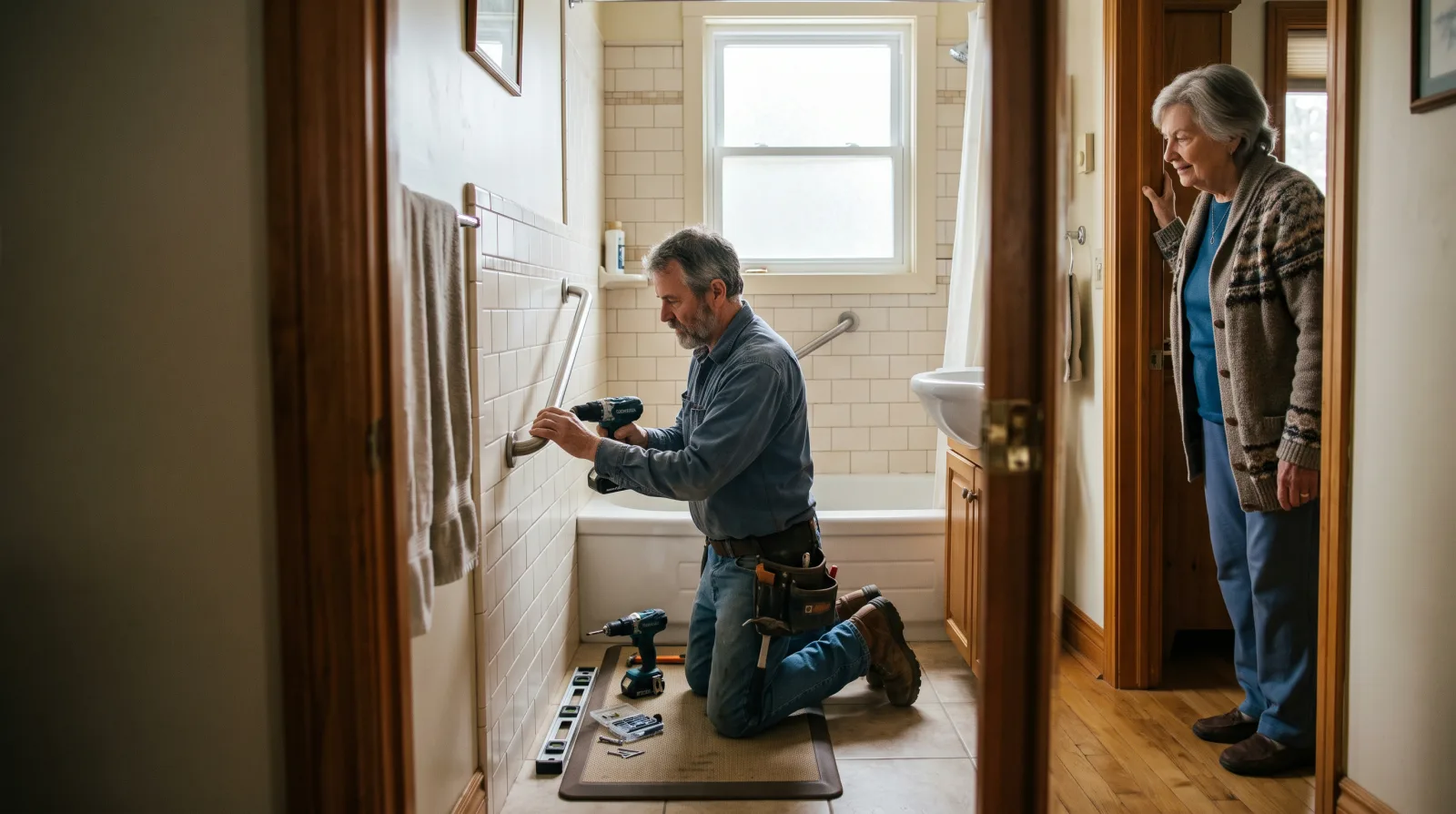
A grab rail in the shower and a basement apartment for a parent sit at opposite ends of the renovation budget, yet the Income Tax Act treats both as things worth subsidizing. It does so through two separate credits with different shapes: one small and non-refundable, aimed at making an existing home safer to live in; one larger and refundable, aimed at adding a second home inside the first. Knowing which project belongs to which credit, and where the two overlap with the medical expense claim, decides how much of a contractor's invoice comes back at tax time.
The Home Accessibility Tax Credit, line 31285
The HATC covers renovations that let a qualifying individual access, move around in, or function within their home, or that reduce the risk of harm there. A qualifying individual is someone who is 65 or older at the end of the year or who is eligible for the disability tax credit at any time in the year. Up to $20,000 of eligible expenses per year can be claimed for that person's dwelling, and if two qualifying people share a home the $20,000 is shared, not doubled. The credit is non-refundable, so it reduces tax owing but does not produce a refund on its own.
The rate is not written into the credit as a fixed number. Like most federal non-refundable credits it uses the lowest personal tax rate, which Bill C-4 lowered to 14.5 per cent for 2025 and 14 per cent for 2026 and later years. On a full $20,000 claim that is $2,800 of federal tax saved in 2026, a little less than the $3,000 the credit was worth when the lowest rate was 15 per cent.
Who claims it, and for which home
The claimant can be the qualifying individual, their spouse or common-law partner, or a relative who claimed (or could have claimed) a dependant or caregiver amount for them. The dwelling must be in Canada, owned by the qualifying individual or by the claimant, and ordinarily inhabited by the qualifying individual. A daughter who owns the house her 80-year-old father lives in can claim the ramp she had built for him.
What counts: enduring, integral, and not for resale value
Eligible work must be of an enduring nature and integral to the dwelling: walk-in bathtubs, grab bars, wider doorways, ramps, stair lifts, lowered counters, non-slip flooring. Materials, fixtures, equipment rentals, plans and permits all count, as does a contractor's labour. Your own labour and your own tools do not. Work by a relative is eligible only if that person is registered for GST/HST. The exclusions are the ones you would expect: routine maintenance, appliances and home-entertainment devices, housekeeping or security monitoring, financing costs, items that can be used independently of the renovation, and any project whose main purpose is to raise or protect the home's value.
One receipt can support both the medical expense claim and the accessibility credit, but the two renovation credits never share a dollar.
The Multigenerational Home Renovation Tax Credit, line 45355
The MHRTC, available since the 2023 tax year, is for a different kind of project: creating a self-contained secondary unit, with its own private entrance, kitchen, bathroom and sleeping area, so that a qualifying individual can live with a qualifying relation. The qualifying individual is someone 65 or older by the end of the year the work finishes, or an adult of 18 or more who is eligible for the disability tax credit. The relation must be 18 or older and a parent, grandparent, child, grandchild, sibling, aunt, uncle, niece or nephew of that person or their spouse. The unit can be newly built or converted from existing space and must meet local requirements.
The credit applies to the lesser of qualifying expenditures and $50,000, and it is refundable, so it is paid out even to a household with little or no tax to offset. The CRA's description puts it at 15 per cent, or $7,500; the legislation uses the same "appropriate percentage" as the HATC, which is 14 per cent for 2026, so a renovation completed this year should be worked out at that rate, or $7,000 on a full $50,000. It is claimed on Schedule 12 in the year the renovation period ends, and only one qualifying renovation can ever be claimed for a given qualifying individual.
| Feature | Home Accessibility Tax Credit | Multigenerational Home Renovation Tax Credit |
|---|---|---|
| Purpose | Safer access and mobility in an existing home | A self-contained secondary unit for a relative |
| For whom | Person 65+ or DTC-eligible | Person 65+ or DTC-eligible adult, living with a qualifying relation |
| Expense cap | $20,000 per year | $50,000, once per qualifying individual, lifetime |
| Refundable? | No | Yes |
| Illustration | $12,000 bathroom conversion: 14% = $1,680 off federal tax in 2026 | $65,000 basement suite finished in 2026: capped at $50,000, 14% = $7,000 refundable |
Rates follow the lowest federal rate for the year the claim is made (14% for 2026). Figures are illustrative and ignore provincial credits, which some provinces add on top.
Where the credits meet, and where they do not
The two credits do not stack on the same expense. An invoice claimed under the MHRTC cannot also be claimed under the HATC or as a medical expense, and vice versa. The HATC and the medical expense tax credit are the exception: the CRA states that an expense which qualifies as both can be claimed under both. Renovations count as a medical expense only in narrower circumstances, broadly where a person with a severe and prolonged mobility impairment needs them and the work would not typically add to the home's value, so a walk-in tub for a parent with such an impairment may earn both, while a ramp installed for convenience at 66 earns the HATC alone. Grants from a government program do not reduce the HATC; reimbursed or rebated amounts cannot be claimed under the MHRTC.
Some provinces add their own renovation credits on top, and Quebec runs its own system; check the provincial return as well.
Good to know
Neither credit requires receipts to be sent in, but both require them to be kept: vendor name, address and GST/HST number, a description of the work with dates, the amount, and proof of payment. Condominium corporations must give you a signed statement of your share of any common-area work.
Who this matters for, and what to check
- Households with a member aged 65 or older, or approved for the disability tax credit, planning safety or access work: budget around the $20,000 annual HATC cap, and consider spreading a larger project across two tax years.
- Families adding a suite for a parent or an adult child with a disability: confirm the unit will be fully self-contained and meets local by-laws before the first invoice, since the MHRTC can be claimed only once for that person.
- Decide in advance which credit each invoice will support; the MHRTC excludes anything already claimed elsewhere.
- If the work is also medically necessary for a mobility impairment, keep a letter from the practitioner so the same receipts can back the medical expense claim.
The takeaway
The HATC is the everyday credit: up to $20,000 of enduring accessibility work a year for a home where someone 65 or older or DTC-eligible lives, worth about $2,800 in federal tax at 2026 rates. The MHRTC is the once-in-a-lifetime one: a refundable credit on up to $50,000 for a genuine second unit. Older homeowners weighing a renovation against moving may also want to read how OAS and GIS interact with other income, and anyone financing work at renewal time can see what a lender must disclose.
Official sources
- CRA, Line 31285: Home accessibility expenses: $20,000 cap, qualifying and eligible individuals, eligible work, overlap with medical expenses, records
- CRA, Multigenerational Home Renovation Tax Credit: $50,000 cap, refundable, secondary unit definition, qualifying relation, one claim per lifetime, exclusions
- Income Tax Act, s. 122.92 (MHRTC): credit = appropriate percentage x lesser of expenditures and $50,000
- Income Tax Act, s. 118.041 (HATC): credit = appropriate percentage x lesser of expenditures and $20,000
- Finance Canada, Report on the impact of reducing the lowest rate on non-refundable tax credits: lowest rate 14.5% for 2025, 14% from 2026; credits including home accessibility follow it; Top-Up Tax Credit 2025-2030
General information
This article is sponsored information from Delta Management OÜ, the publisher of Gobasco (company details). Gobasco is a private, independent website. It is not a government website and is not affiliated with the Government of Canada, the Canada Revenue Agency, Service Canada or any provincial or territorial government. It is general information, not personal tax, legal or financial advice, and it does not recommend any product or provider.
Figures are the official published amounts for the period stated or clearly labelled illustrations; what any one person receives or pays depends on their own circumstances and on the official assessment. This site processes no applications and charges no fees. Never give your Social Insurance Number, CRA My Account credentials, bank login or one-time passcodes to a website in response to an article. For your own position, use the official services of the agency concerned on canada.ca or your provincial government’s website.
 The Wednesday Brief
Don’t miss a change
One email each Wednesday with what has changed in Canada’s benefits, tax, savings and household costs, and the official source for each figure. Nothing to buy.
We first send a confirmation email. Free, and you can unsubscribe at any time.
Gobasco Editorial
Our editorial desk explains Canada’s household-money rules from the published sources of the agencies concerned. We do not name individual writers, we do not sell financial products and we take no applications. Corrections: editorial@gobasco.com.



 Tax